
Introduction
As part of our project to find the Ables Viking, we did some AUV scanning with UCSD/Scripps and one of the targets identified was what looked to be a debris field. A diagram of the possible targets is shown below. The initial search grid was about 1 square kilometer and was based on a diagram in the accident report.
We dove the “WING” target with the green pin later this same day and we are hopeful it is from the S-3 Viking we are searching for.
This dive was our first dive of the day and is the one that is labeled “WW II Airplane Debris Field” in the diagram below. At the time, we just thought the sonar image looked like a debris field and was worth diving.

A friend had actually alerted us to a possible wreck at this location a couple years ago; however, when we scanned the site we got almost no return on the sonar or sidescan so we passed on diving it.
Below is a redacted version of my notebook from 17 February 2024 with the comments “pretty much a desert.”

However, we now had data from the AUV that did seem to indicate that there was some very distributed debris and needed to go dive it.


I know it doesn’t look like much, but those indentations in the diagram are pretty evident of something….
The Dive
It was our first dive of the day on the Marissa and I had asked Cody Cordero to join us. I’ve done some diving with Cody in the past and he is a solid diver and always up for some adventure and realizes that we can either find rocks or possibly a new airplane!
Similar to the last time we looked this site on sonar, we had very, very little return. Below are some screen captures of the sonar system. Given that the AUV indicated a good chance of a debris field AND we had been alerted to this exact location from another friend, we did our best to find the “center” of the debris and dropped the downline. There is definitely evidence of fish in one of the sonar images but there is very, very little structure evident.


Cody and I got geared up and ready to dive. Since we figured it would be a distributed debris field and I would be taking photos, I had asked Cody to run a separate line from the downline so that we could find our way back for our ascent and decompression obligation.
We got to the bottom and it was pretty good visibility but relatively dark and I had to let my eyes adjust. It can sometimes be very hard to find small bits of wrecks when the water isn’t crystal clear and the sun isn’t out. One of the ways to locate debris is to look for small shadows (although your eyes can definitely trick you into thinking you see shadows) and look for fish. I started going out from the down line and making a large circle to my right with Cody following. We started to see a LOT of miscellaneous debris fields.
It was pretty obvious to me from early into the dive that it was airplane debris. I found one oil cooler and then another and also landing gears, fuselage sections, etc. I saw one prop blade mostly buried in the sand and a few other bits and pieces. It was NOT like we got down to the bottom and saw the fuselage of an airplane. This was literally bits and pieces scattered around which means it must have been a pretty violent crash.
I photographed as much as I could but we were running low on time. I got us back to the downline and Cody went to reel in our safety line but it had caught on a small piece of debris so had to re-trace our path and reel it all back in.
Below is a one minute GoPro clip near the end of the dive when I’ve turned my lights off and I’m waiting for Cody to reel back in the line. It gives a good sense of the amount of light (or lack thereof) and what some of these structures look like (Note: I’ve increased exposure a full two stops in this clip):
Photos
As mentioned, the debris field is VERY scattered. Each piece is 20+ feet from the next piece so I was taking photographs as much as I could while also trying to find the other pieces of the wreck. Unfortunately, I never found the engine which would have helped greatly with identification.
Dual Oil Coolers
This is one of two key clues. Unless there was a collision and two airplanes crashed, there were two oil coolers. They are very distinctive objects when you are diving a WW II airplane wreck site.


Landing Gears
Another possible clue based on the shape and characteristics. I found what I believe is one main landing gear and one tail landing gear.


Bomb Deployment Device
Tyler spotted this in my GoPro footage and then we found the photos I had taken. We believe that this is a bomb deployment device and not part of the cockpit or other structure. This device was used in dive bombers to make sure the bomb was dispatched away from the propeller during a steep dive bombing descent.
It has the shape of a “wishbone” and I’ve included some red lines in the photo I took to indicate the two prongs that stick out. The photos below are from a Dauntless as an example but we do not believe it is a Dauntless since they didn’t have two oil coolers.


Prop & Hub
We don’t really know how many blades this propeller had (it can often help us determine the airplane type or at least narrow it down). I saw part of one blade that was buried in the sand. There is a “knuckle” on the root area of the prop blade that might be helpful.

Fuselage Section
I don’t think there are any real clues here, but this is the largest section of fuselage I found. It could be from where the wing meets the fuselage given the different angles. I also took enough photos and built a photogrammetry model of this section (more on this very interesting piece of the debris field further below):


Random pieces
I took photos of quite a few other debris fields but nothing that we think is indicative of the type of airplane. Here are some other random pictures of debris. Note that one of them seems to have a piece of glass. Also, there is a hook like object in one photo but it isn’t substantial enough to be a tail hook. There is also what appears to be the rear section of the cockpit canopy.


Airplane Type Identification
It was pretty clear that this was a WW II era plane; however, that leaves open a wide swath of possibilities.
We had a couple of key clues based on the photos; however, I did not find the engine which is one of the easiest ways to identify a plane. Below are some key data points:
- We knew that it had two oil coolers
- I had pictures of one of the main landing gears / tire and the smaller landing gear.
- The prop only had a single blade visible (not sure if the others were buried or broken off) so we couldn’t use the number of blades to further narrow it down
- Tyler had fortuitously noticed a very unique structure when he reviewed my GoPro footage. It looked like an arm that holds a bomb. Further inspection of the photos also showed this.
Therefore, we believe it is a World War II dive bomber that had two oil coolers. Unfortunately, we cannot find any plane that matches both of those. I posted to the WW II Aircraft Forum as I’ve done in the past but didn’t get any info that helped identify it. Here are some possibilities that we examined:
- Vought SB2U Vindicator – this would indeed be an amazing find since there were so few of these produced. The landing gears and the bomb device match and “AI” told us some later variants had two oil coolers but we cannot find ANY evidence of that being true.
- SBD Dauntless – It did have a bomb displacement device but only has one oil cooler in the middle of the fuselage behind the engine
- A-24 Banshee – This was a dive bomber and was the US Army Air Force version of the SBD Dauntless and had a bomb displacement device but not two oil coolers.
- P-47 Thunderbolt – This airplane had two oil coolers but I’m doubtful it had a bomb displacement device and it wasn’t really common in Southern California
- Vought SBU-1 Corsair – This was the old bi-plane Corsair and had a bomb displacement device but only one oil cooler. Later versions of the Corsair had two oil coolers but no bomb displacement device.
- SBC2 Helldiver – The Helldiver was a dive bomber and did have a bomb displacement device. Once again, AI on Google indicated that the -3 variant had two oil coolers but we cannot find any “real” evidence of that.
Two Additional (Related) Possibilities
There are two other possibilities that we are looking into. Both could be very interesting but we are casting a wide net on this one.
- The first is that this is a F4U Corsair. There were plenty of Corsair accidents in the area and they were very prevalent in San Diego. Some variants of the Corsair also had two oil coolers. They didn’t really have a bomb displacement device; however, Tyler has found evidence that some Corsairs were used as bombers and we have found photos of some rigged up bomb holders so it is possible. Most importantly, if you look closely at the screenshot of the photogrammetry model I built, you can notice a couple things
- it looks like the wing has a bend
- there is square area that is similar to the landing gear space and location in Corsairs
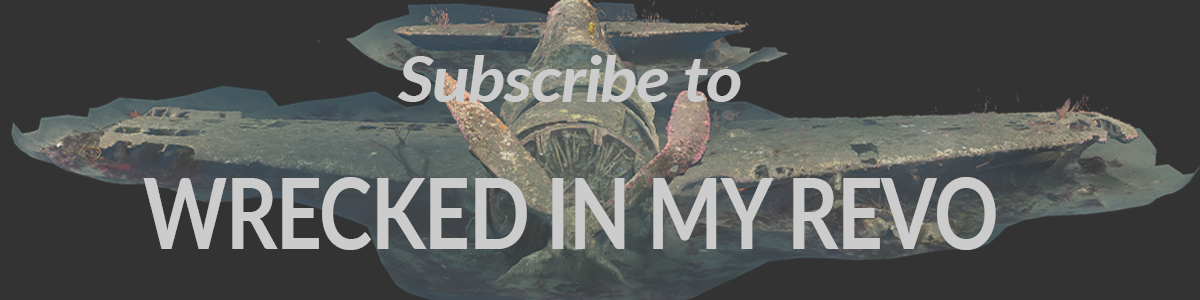
Below is a screen capture of the model I built of the Corsair south of Point Loma (you can also check out the model of the Corsair off Balboa Beach) and then a capture of the piece of fuselage that was present in this debris area:


And below is the “top down” view as well:


One thing to point out explicitly is how very useful photogrammetry is. I don’t think any of us would have recognized that fuselage piece in the debris as a Corsair by individual photos alone.
Below is a link to the online model of this fuselage piece if you want to take a look and move it around and see what you can find!
- The second possibility is that there are two airplanes involved in the accident. Tyler found an article about a collision in that approximate area and one of the planes was a TBF1-C which had two oil coolers but no bomb displacement device AFAIK. Unless we find two engines or more landing gears or something that provides more evidence of two planes involved, for now we are considering it as a single airplane but we aren’t ruling out two planes.
Next Steps
We did one additional dive (details later) of the red pin just to the south of the debris field. We were hoping it would be the engine and that would help identify the aircraft type — but it wasn’t.
I’m not sure if we will go back and dive it again to determine the airplane type. It is an interesting mystery and I’d love to ID the plane; however, we have quite a few other projects on our list. If anybody is conducting a MOD2 class on the Marissa and wants to go dive the target, reach out to me directly and we’ll see if we can arrange that and I will go back and try to find more clues.
For now, we’ll put it on the shelf and maybe get back to it at some point….
Looks like a corsair to me–I see the hallmark inverted gull wing in some of the images. As you stated, some Corsairs had two oil coolers. If you recall the one we dived off Crystal Cove had two.
Yeah, we are pretty sure that section is a Corsair. We just can’t figure out the “bomb displacement” device that is also there.